


Health and Safety for Manufacturers in the Midlands:
What Every Engineering Business Needs to Know | LESH Consulting
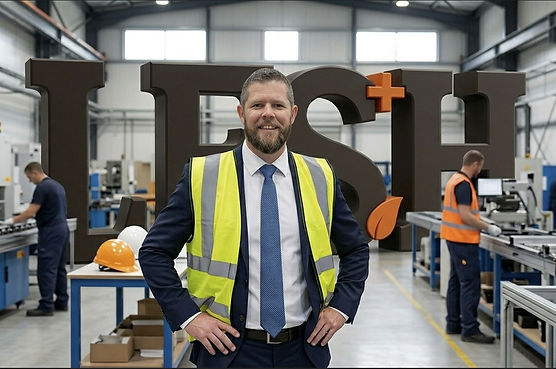
If you run a manufacturing or engineering business in Nottinghamshire or the wider East Midlands, health and safety compliance is not optional — and it is not simply a box-ticking exercise. It is a legal obligation, a moral responsibility to your workforce, and increasingly, a commercial necessity when tendering for contracts.
The reality is that H&S law applies to every business with employees, regardless of size. But manufacturing and engineering environments carry specific risks — machinery hazards, noise exposure, hazardous substances, fire risks, manual handling, working at height, and complex construction projects — that demand specialist knowledge, not just a generic policy document downloaded from the internet.
At LESH Consulting Ltd, we work almost exclusively with manufacturers, engineering companies, and construction businesses across Nottinghamshire, Derbyshire, Leicestershire, and the broader East Midlands. In this article, we want to explain clearly what the law requires, where businesses most commonly fall short, and how a local, qualified health and safety consultant can genuinely make a difference.
! | Who this article is for This guide is written for business owners, operations managers, and directors of manufacturing and engineering SMEs in Nottinghamshire and the East Midlands who want to understand their H&S obligations clearly and practically. |
Why Health and Safety Matters More in Manufacturing and Engineering
The statistics are stark. According to the Health and Safety Executive (HSE), manufacturing consistently accounts for one of the highest rates of workplace injury in the UK. In 2023/24, over 33,000 workers in manufacturing reported non-fatal injuries, and the sector saw a disproportionately high number of fatal accidents relative to its size.
Engineering environments compound this. Workshop machinery, fabrication equipment, overhead cranes, forklift trucks, compressed gases, chemicals, and the physical demands of production work all create hazards that, if poorly managed, can result in life-changing injuries or fatalities.
Beyond the human cost, the financial consequences of a serious incident are significant: HSE investigations, improvement notices, prosecution, unlimited fines, civil claims, reputational damage, and lost production. For an SME, a single serious incident can threaten the business entirely.
Good health and safety management is not just about avoiding fines. It protects your people, reduces sickness absence, improves productivity, and increasingly, it determines whether you win contracts. Many larger clients, framework agreements, and public sector tenders now require SSIP accreditation or proof of competent H&S management before they will work with you.
The Legal Framework: What the Law Requires of You
UK health and safety law is primarily governed by the Health and Safety at Work etc. Act 1974 (HSWA) and a series of Regulations made under it. For manufacturers and engineering businesses, the most relevant legislation includes:
• Management of Health and Safety at Work Regulations 1999 — requires suitable and sufficient risk assessments, a written H&S policy (5+ employees), and access to competent health and safety advice.

• Provision and Use of Work Equipment Regulations 1998 (PUWER) — requires that all machinery and work equipment is safe, properly maintained, and subject to regular inspection. This is one of the most commonly breached regulations in manufacturing.

• Control of Substances Hazardous to Health Regulations 2002 (COSHH) — applies to any business using oils, solvents, cleaning chemicals, welding fumes, dusts, or other hazardous substances. Assessment, control, and monitoring are all required.

• Control of Noise at Work Regulations 2005 — if your workers are regularly exposed to noise levels above 80 dB(A), you have legal duties to assess exposure, control risks, and provide hearing protection where necessary.

• Regulatory Reform (Fire Safety) Order 2005 — requires a suitable fire risk assessment for all non-domestic premises. In manufacturing and engineering, fire risk is often elevated by flammable materials, hot work, and complex storage arrangements.

• Construction (Design and Management) Regulations 2015 (CDM 2015) — applies to any construction work, including refurbishment, fit-out, or extensions to your premises. Duties apply to clients, principal designers, and principal contractors.

• Reporting of Injuries, Diseases and Dangerous Occurrences Regulations 2013 (RIDDOR) — requires reporting of workplace fatalities, specified injuries, over-seven-day injuries, and dangerous occurrences to the HSE.

This is not an exhaustive list. Depending on your specific activities, additional regulations may apply — working at height, lifting operations, electrical safety, manual handling, and more. The key requirement is that you have a competent person helping you to understand and manage these duties.
? | What is a 'Competent Person'? Under regulation 7 of the Management of Health and Safety at Work Regulations 1999, every employer must appoint one or more competent persons to assist with health and safety. For most SMEs, this means appointing an external health and safety consultant with relevant qualifications and sector experience. LESH Consulting provides this service under our Competent Person Service — visit leshonline.co.uk for details. |
The Five Areas Where Manufacturers in the Midlands Most Commonly Fall Short
Based on our work with manufacturing and engineering businesses across Nottinghamshire and the East Midlands, these are the five compliance areas we most regularly find are inadequate or out of date:
1. PUWER — Machinery That Has Never Been Properly Inspected and is Unsafe
PUWER requires that work equipment is suitable, maintained, and inspected. In practice, many businesses have machinery on the shop floor that has never had a formal PUWER assessment — particularly older equipment, second-hand plant purchased without documentation, or equipment that was moved from another site.
A PUWER assessment identifies whether each piece of equipment is suitable for its intended use, whether guarding is adequate, whether operators are trained, and what maintenance regime is in place. It is not optional — and the HSE actively inspects for it in manufacturing environments.
See below recent court cases involving machinery:
2. Risk Assessments That Are Generic and Not Site-Specific
Many businesses have a folder of risk assessments — but they are generic, not reviewed in years, and do not reflect the actual work being carried out. A risk assessment must be suitable and sufficient for the specific task and workplace. Generic templates from the internet rarely meet this standard.
We regularly carry out H&S audits for manufacturers where the risk assessments on file bear little resemblance to the actual operations on site. This is not just a compliance failure — it means that the assessment provides no real protection for workers.
3. Fire Risk Assessments That Are Absent or Grossly Out of Date
Under the Regulatory Reform (Fire Safety) Order 2005, every non single domestic premises (everything other than a single home) must have a fire risk assessment carried out by a competent person. Manufacturing sites are particularly high-risk — combustible materials, hot work, complex layouts, shift patterns, and multiple means of escape all need to be assessed.
A fire risk assessment is not a one-off document. It must be reviewed regularly and updated whenever there is a significant change to the premises, occupancy, or activities. We carry out fire risk assessments for manufacturing and engineering sites across Nottinghamshire, Derbyshire, and Leicestershire.
4. No Process for Managing Contractors and CDM
If you bring contractors onto your site for maintenance, installation, or construction work, you have legal duties under CDM 2015. As a client, you must ensure that contractors are competent, that there is a suitable principal contractor, and for notifiable projects, that a principal designer has been appointed.
Many manufacturing businesses are entirely unaware of their duties as a CDM client. We can advise on your specific obligations and, where needed.
5. Noise and COSHH Assessments That Have Never Been Carried Out
Manufacturing is one of the noisiest working environments in the UK. Yet many businesses have never carried out a formal noise assessment or monitoring survey. Without measured data, you may struggle to demonstrate compliance with the Control of Noise at Work Regulations, and you cannot identify workers at risk of hearing damage.
Similarly, COSHH assessments for oils, cutting fluids, welding fumes, and chemical cleaners are often absent or incomplete. The HSE has significantly increased enforcement around welding fume exposure in recent years following evidence of its carcinogenic properties — this is an area where compliance failures carry real risk.
How LESH Consulting Supports Manufacturers Across the East Midlands
LESH Consulting Ltd is a specialist health, safety, and fire consultancy based in Kirkby in Ashfield, Nottinghamshire. We work with manufacturing and engineering businesses across the East Midlands — from small workshops in Mansfield and Sutton in Ashfield to larger industrial sites in Nottingham, Derby, Leicester, and Chesterfield.
What makes us different from a large national consultancy is simple: we are local, we are accessible, and we understand the sector. We are not sending a generalist consultant who has never been on a factory floor. We work in these environments day in, day out. We have a results over reports approach, meaning we advise what you need to do, not just tell you its wrong (which appears to be the norm).
Our H&S Services for Manufacturers | Areas We Cover |
• Competent Person Service (retained H&S support) • PUWER / Machinery Safety Assessments • Fire Risk Assessments • H&S Audits and Inspections • Risk Assessment and Policy Writing • COSHH Assessments • Workplace Noise Monitoring • CDM Advisor • Accident Investigation • SSIP / Accreditation Support • ISO 45001 and ISO 14001 Support • H&S Training | • Kirkby in Ashfield • Sutton in Ashfield • Mansfield and Mansfield Woodhouse • Hucknall and Annesley • Nottingham City and suburbs • Chesterfield and North Derbyshire • Derby and South Derbyshire • Huthwaite, Alfreton, and Ripley • Newark, Worksop, and Retford • Loughborough, Leicester, Lincoln • Throughout the East Midlands |
The Value of a Retained Health and Safety Consultant
For most manufacturing SMEs, the most cost-effective solution is a retained health and safety consultancy arrangement — where we act as your outsourced H&S department on a monthly basis. This gives you access to qualified, sector-experienced support without the cost of a full-time H&S manager.
In addition to our Competent Person Service, we offer ongoing support covering policy and documentation management, risk assessment review, site visits and inspections, incident support, regulatory updates, and a dedicated phone line for day-to-day queries. For many of our clients, it is the first time they have had a genuinely competent person available to them when they need it.
A retained arrangement also means that when the HSE comes knocking — or when a client asks for proof of your H&S management — you are ready. You have current documentation, qualified oversight, and a track record of proactive compliance.
i | Did you know? Businesses with effective health and safety management systems typically see a reduction in sickness absence, lower employer liability insurance premiums, and a stronger position when tendering for contracts that require SSIP accreditation or pre-qualification questionnaire (PQQ) evidence. |
Getting SSIP Accreditation: A Gateway to More Contracts
If your business wants to work with larger clients, local authorities, housing associations, or public sector organisations, you will almost certainly be asked to provide proof of SSIP (Safety Schemes in Procurement) accreditation — such as SafeContractor, CHAS, Constructionline, or Acclaim.
SSIP accreditation demonstrates to clients that your health and safety management meets a recognised standard. For manufacturing and engineering businesses that supply services or plant onto third-party sites, it is increasingly non-negotiable.
LESH Consulting can support you through the SSIP application process — ensuring your documentation is in order, your risk assessments are suitable, and your submission gives you the best possible chance of accreditation at first attempt. We have helped businesses across Nottinghamshire achieve and maintain their SSIP accreditation efficiently and without the stress of navigating the process alone.
Ready to Talk? Here Is How to Get Started
Whether you need a one-off fire risk assessment, a PUWER inspection of your machinery, or ongoing retained H&S support, we make it straightforward to get started.
We offer a free, no-obligation initial consultation — usually a 30-minute call to understand your business, your current position, and what you actually need. No hard sell, no unnecessary complexity. Just practical advice from a local consultant who knows your sector.
Get in Touch with LESH Consulting Ltd
Specialist Health, Safety & Fire Consultancy | Nottinghamshire & East Midlands
Phone: 01623 239705 Email: Info@LESHonline.co.uk Website: www.leshonline.co.uk Free Consultation: Book via our website — no obligation, no pressure |
About the Author
This article was written by the team at LESH Consulting Ltd, a specialist health, safety, and fire consultancy based in Kirkby in Ashfield, Nottinghamshire. LESH Consulting provides H&S consultancy services to manufacturing, engineering, and construction businesses across the East Midlands, including Nottingham, Mansfield, Derby, Leicester, Chesterfield, and surrounding areas. For more information, visit www.leshonline.co.uk.
Related Articles:
https://www.leshonline.co.uk/post/company-fined-after-worker-entangled-in-horizontal-borer-machinery


Comments